Choosing the Right Corner Base Cabinet: Blind Corner, Easy-Reach, or Lazy Susan?
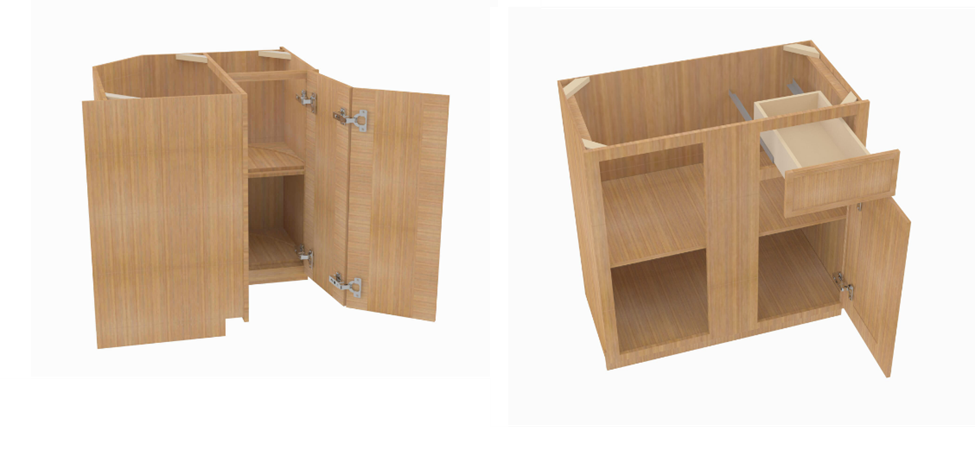
Corner base cabinets are one of the most overlooked — and most debated — decisions in kitchen design. While they don’t always stand out visually, they play a major role in storage efficiency, accessibility, and overall layout flexibility.
Homeowners and contractors usually narrow their options down to three common solutions: traditional blind corner cabinets, easy-reach corner cabinets, and lazy Susan base cabinets with rotating trays. Each has advantages depending on space constraints, door width, and how the kitchen will be used.
1. Traditional Blind Corner Base Cabinets
Blind corner cabinets are the most traditional option and are often chosen for budget-friendly layouts or highly constrained floor plans. These cabinets extend into the corner while leaving part of the cabinet “blind” or hidden behind an adjacent cabinet run.
A key installation rule with blind corner cabinets is allowing a minimum 3-inch filler space between the cabinet and the wall. This clearance ensures proper door operation and prevents handle or hinge interference.
Blind corner cabinets are typically available in multiple widths, making them flexible for unusual layouts. However, the main downside is accessibility — items stored deep inside can be difficult to reach without pull-out accessories.
Best for:
- Tight budgets
- Custom corner dimensions
- Installations where maximizing linear cabinet runs matters more than access
See also: Revolutionizing Industrial Monitoring with Modern Technology
2. Easy-Reach Corner Cabinets (No Spinning Trays)
Easy-reach cabinets are designed to solve the accessibility issue of blind corners without adding moving parts. Instead of rotating trays, they use angled shelving that opens toward the user.
These cabinets offer:
- Better visibility than blind corners
- No mechanical components to maintain
- Cleaner interior space for larger items
Easy-reach cabinets are commonly available in 33-inch and 36-inch sizes. The 33-inch version features a slightly narrower door opening, which can be limiting but is sometimes necessary when wall space or appliance placement restricts cabinet width.
Best for:
- Homeowners who prefer simplicity
- Kitchens where spinning trays are not desired
- Medium-sized layouts with moderate constraints
3. Lazy Susan Base Cabinets with Spinning Trays
Lazy Susan cabinets remain one of the most popular corner solutions due to their unmatched accessibility. Instead of reaching deep into a cabinet, rotating trays bring stored items directly forward with minimal effort.
Most modern lazy Susan cabinets come with:
- Two full-round or kidney-shaped spinning trays
- Reinforced shelf supports
- Soft-close doors depending on hardware choice
Like easy-reach cabinets, lazy Susan base cabinets are typically offered in 33-inch and 36-inch widths. The 36-inch size provides a wider door opening and slightly more usable storage, while the 33-inch version is often chosen when layout constraints leave no other option.
For kitchens where efficiency and ease of use matter, a 36-inch lazy Susan base cabinet with rotating shelves is often the most practical long-term solution.
You can see a real-world example of this type of cabinet here:
36-inch Lazy Susan base cabinet with rotating trays
33″ vs 36″: Why Door Width Matters
While the difference between 33 inches and 36 inches may seem minor on paper, it has a noticeable impact on daily use:
- 33-inch cabinets
- Narrower door opening
- Sometimes unavoidable due to layout constraints
- Slightly reduced access to trays
- 36-inch cabinets
- Wider door opening
- Easier loading and unloading
- Better long-term usability
When space allows, most designers recommend opting for the larger size — especially in high-use kitchens.
Final Thoughts
Choosing the right corner cabinet isn’t just about fitting boxes into a floor plan. It’s about how the kitchen will function years down the line. Blind corner cabinets offer flexibility and affordability, easy-reach cabinets balance simplicity and access, and lazy Susan cabinets deliver the most convenience for everyday use.
Understanding your layout constraints — including wall clearances, cabinet spacing, and door swing — will ultimately determine which option makes the most sense.